Lunedì prossimo (27 ottobre) dovrei fare lezione agli studenti del Corso di Laurea Magistrale Teorie della Comunicazione per l’insegnamento Tecnologia di Comunicazione online.
Tuttavia la facoltà di Facoltà di Scienze della Formazione potrebbe essere occupata per via delle agitazioni relative alla Legge 133. Si pone quindi il problema di cosa fare.
Propongo di fare la lezione in piazza. È una proposta che faccio senza fanfare e con il desiderio di dare una piccola testimonianza di un dissenso molto ampio e che non deve essere assolutamente strumentalizzato confondendolo con un movimento di parte o peggio con una vocazione all’ozio e alla vita facile.
Non ho idea di dove si potrebbe fare e non ho particolari preferenze: il giardino all’interno della Facoltà di Scienze della Formazione? Ponte Vecchio? Altrove?
Vorrei che foste voi studenti a fare delle proposte che mi potete inviare commentando questo post, scrivendomi in Twitter, in Facebook o per email (andreas DOT formiconi AT gmail DOT com.
Di cosa si potrebbe parlare? Della complessità del mondo e in particolare della complessità del mondo nel quale viviamo la nostra identità di esseri sociali e nel quale lavoriamo. Di come le istituzioni, le organizzazioni, le strutture si stiano rivelando inadeguate ad affrontare tale complessità. Di come stiano emergendo infrastrutture, fenomeni sociali, forme di creazione e produzione, strategie industriali che stanno cambiando profondamente la visione del mondo e che forse offrono nuove opportunità per affrontare i grandi problemi che gravano su di noi.
Non dovrebbe però essere un discorso particolarmente erudito o tecnico bensì un discorso per ricordarci che, se mai vi sono delle nuove opportunità, queste possono essere colte solo attraverso all’impegno personale, al recupero della capacità di stupirsi, alla disposizione ad appassionarsi, a perseverare, a rischiare, ad un atteggiamento aperto, alla condivisione.
Beninteso, se l’occupazione non dovesse avere luogo allora ci vedremo come lunedì scorso nell’aula informatica della Facoltà di Scienze della Formazione in via del Parione 7 e di queste cose parleremo in modo più diffuso negli incontri successivi.
In the short paper 1 I said that often one has the feeling that ideas flourish just because the context is mature. Here again.
Renata Phelps is a professional and I’m not, coming recently from other fields. I heard nothing about such ideas in my entourage here. I had absolutely no specific background. I had just to face a large and complex problem: to teach something
changing too fast
to too many students
having extremely different backgrounds.
Nothing else.
And probably, in some other parts of the world there are other people developing similar solutions to similar problems without having an explicit and common background on the subject. Solutions that are in the air brought by a set of hidden connections.
Italy’s economy is struggling. Among the cost-cutting measures we have a bill proposed recently to dispose of about 2000 temporary research staff, who are the backbone of the country’s grossly understaffed research institutions.
The bad new is so bad to appear in a note of one of the most important scientific journals, Nature455, 835-836 (16 October 2008), where we are reminded that Italy spends barely 1.1% of its gross domestic product after having signed up to the European Union’s 2000 Lisbon agenda, in which member states pledged to raise their research and development (R&D) budgets to 3% of GDP.
Yes, let’s go for a walk in a wood and relax as many times as you like and with the passing of time you will know that wood in your own way. This means you will be looking for something there and you will disregard the rest.
Jørgen asked me if I’m establishing valuable connections in this course. Yes, I do. Moreover, patterns begin to emerge and it is easier to choose what it is worthwhile to follow but the choice is personal, depending on its own interests and needs.
As far as my connections are concerned, these depend on my wish to improve what I’m trying to offer to my student. Specifically, I’m willing to
1) share my teaching experiences
2) learn from teaching experiences of others
3) gather some general background that may improve teaching practice
4) learn about some useful tools.
Consequently, I like posts that report on teaching experiences or make points that may be of some interests in real teaching practice. In particular, I’m interested in experiences made to test the idea that by means of Web 2.0 tools it is possible to improve the learning experience of students substantially.
For instance the blogroom I’m trying to describe in this blog, represents the attempt to transform the classroom group in a network where concern for others, responsibility for contribution, commitment, getting something accomplished are basic values. Values that are extraneous to the classroom group, where each student works for himself and almost only for a good grade, which rarely means to get something accomplished, I mean really accomplished. I have hundreds of students saying this when asked to give their opinion about the course, four of them provided a translation.
When talking about networks applied to education we should think to a farmer taking care of its field and its crops. With farmer I intend the contadino of first or middle 900 in Italy. Old farmers loved their piece of land and knew what to do to let crops grow by themselves.
We cannot say: “Look these networks, what a mess!” Of course, if there is nobody to take care of them. This is the role of the teacher in network teaching: to create conditions so that the students will learn, share, cooperate, really achieve something autonomously. And they love it if only we give them an opportunity.
In classroom groups the teacher controls processes. In networks teaching the teacher takes care of its network, as the farmer takes care of its crops. We have to love our students. We have to love our network of students. It is such love that will guide us in using technologies appropriately.
Now I have seen, with great joy that there are people sharing, in some ways, this vision.
There are other blogs that often give me the feeling to learn something useful when I read them. I will put them in the blogroll here but I’m afraid to miss something interesting somewhere. Therefore, a couple of questions:
If someone is reading this post feeling to have similar experiences to share or to quote, please, let me know.
Is there anyone who is thinking or even trying to extract some patterns of clustering in this course? I mean to find who is primarily interested in theories, or ideological aspects, or sharing teaching experiences and so on?
In other words, if, for instance, I find myself looking for mushrooms more and more often, well, this means that probably my way of knowing the wood is through the mushrooms I can find there and I will look for mushrooms, definitely, trying to not miss the good ones.
Life struggles to emerge from the inexorable increase of entropy stated by the second law of thermodynamics with two legs: groups and networks.
As usual, we tend to dichotomise the discussion.
Groups and networks are synergic. Nodes are not a sort of dimensionless points but have structure. Internal structure of nodes is related to their functionality within the network.
Nodes “are” groups. I mean, Nature creates groups to function as nodes in networks.
Nodes require internal structure and hierarchical organization to function. Networks grow spontaneously, or better said, chaotically. Our world is entirely made of chaotically grown networks made of structured nodes.
How do we build a car today? I read of a new chinese car which is chinese because its conception and the management of the industrial process took place in China. However, the various systems that compose the car are manufactured in US, Germany, Austria, China and some other places. The car will be assembled in south Italy. This is the trend. Today you buy a car of a given brand but more then 50% of that car has been designed, built and assembled not by the brand you choose but by a worldwide network of suppliers. Do you need brakes for a new car? Well, you have to choose among all the available brake manufacturers and you will connect to those who will be able to provide the brakes you need at the lowest cost. The nodes of this industrial network are companies. Companies are highly structured groups of people. All the employers of a company are members of a group organized in a strictly hierarchical way. The company, in order to function behaves as a node in a network characterized by a very well defined set of rules. However, the network grows chaotically.
Our society is made of communities, ranging from minuscule villages to very large metropolis. All these communities are very structured groups of people. There have always been communications among communities, even a long time ago. Our society have been always shaped as a network of communities. But the network of communities grows spontaneously. Villages and towns rise because of a very complex blending of factors. Nobody has planned the whole distribution of towns in a country. Scaring experiments, such as in the implementation of communism, have been made but they all ruined in human tragedy.
The world of open source is a network of software developers. Each developer acts as a node in this network. Each developer is a human being, that is an extremely complex group of cells organized in a set of very complex structures.
The most complex of these structures is the brain which in turn is a network whose nodes are nervous cells. A single nervous cell is a very structured group of macromolecules.
And so on.
Our discussions are always too anthropocentric. We believe to take fundamental decisions about the use of groups or network. It is not so. Things happen. Just happened that way before us. And they will happen despite us.
This does not means that we are condemned to be passive observers of our destiny. Not completely. The world changes continuously, evolves continuously and we find ourselves in the mainstream of evolution but, fortunately or unfortunately, we have consciousness and we are able to take decisions.
Here it is important to improve our understanding of the relationships between networks and groups because the world use both of them. I would like to understand better the role of groups as nodes in networks.
I would like to understand better the balance between chaos and structures which produce stable stratified networks, despite the second law of thermodynamics.
You belong to the curriculum for Radiologic, Radiotherapy and Nuclear Medicine Technologists (TRMIR in local jargon). Next monday other curricula will join.
Let’s recap here what we said in classroom.
Basics
Contents are available in the wiki but my attention will be focused on your activities and not on your assimilation of contents. By means of the activities you should learn to integrate contents written by me with Open Educational Resources (OER).
Is not me, your teacher, who plans your path but you, each one for himself. You can choose among three different ways to follow the course.
We met last week and we will meet once again after the next couple of weeks (as specified on the calendar in our wiki) but only those who need to discuss something are supposed to be there.
Otherwise, you are autonomous. I will be available in the computer classroom in Firenze as specified on the calendar in the wiki front page (Verbali ed esami) to discuss with you any possible issue.
You can ask me for lectures or seminars on specific topics that you find particularly difficult or interesting for you.
Follow my blog (posts in category INF08) to know what’s going on.
Pose any questions, technical ones as well as organizational ones, in the forum.
Your choices
You have three basic options:
The conventional way. You will study available contents and pertinent OER. At the end you have a multiple choice test.
The way for those who already have particular skills and would like to share their expertise. You can go and browse the contents in the wiki. If you will find a section that you believe to be able to update or to improve then write me. We will discuss your contribution. If you will do a valuable work you will get a B or A grade (30 o 30 e lode).
The new way. You have to create a blog or use an existing one. You have to keep track of this blog, the forum and the wiki. In my blog you will be asked to do some activities. Just a few of them will be mandatory, some will be optional. You are encouraged to invent new activities. I will value creativity, cooperation, sharing. I will build grades using 1-5 scores for each activity. Your grades will just build with your activities, there is no time limit and no predetermined order in the sequence of activities.
You may also mix these paths.
How to begin and sign in the course
Go to the sign in page (Iscrizione studenti) and follow instructions to enter the wiki. There are two short videos.
Edit the appropriate page according to your curriculum by writing your email address. Just the email address!
Read carefully the course description (Descrizione del corso) and the social networking chapter (Social Networking). This readings will allow you to choose one of the three available options.
In the meanwhile, I will send to you a link by email. There you will find a form where, once you have chosen your option, you will have to specify name, university identification number, email, blog address and some other items. The form is related to a Google spreadsheet where I will find your data ordered in an appropriate way. Only name, number and email are mandatory. If I will find a blog address then I will assume that you chose the third option, otherwise I expect to see you in the test days or to discuss a specific contribution.
How to use your blog
You should see the blog as an exercise book (quaderno). After the course you can throw it away or you can keep it and use it as you like.
I will suggests activities in my blog. I will do this with a certain pace but you can go on with your own pace.
You are supposed to write required contributions in your blogs. You are also encouraged to use the blog as a communication device. You can write what you want and put there any gadget you like with just one fundamental constraint:
do respect others and their opinions
If you feel shy you can use the blog just to write what it is required by the course. To use a blog does not imply to put your inner ego into the open. It is just a powerful communication instrument and it is up to you how to use it.
Grading
In conventional courses time is a constraining parameter. One starts with the first lecture, then there are a sequence of lectures and other activities, then you have a final test, kind of a race photofinish, where you get your grade.
Here the constrain is not time but the minimum quality of learning. You can require as much time you need; just try to plan carefully. You will perform a sequence of activities. I will tell you when the activities you have done will correspond to a minimum acceptable quality. Since I’m obliged to produce grades I will quantify the mimimum acceptable quality to a grade of C, say 25-27/30 in the cumbersome Italian grading system. You can try to improve your grades with further activities if you like.
When you try to do something take your time to do it very well
If you have to choose among several activities begin with the most amusing for you
Have a good time!
To read about connectivism is somewhat funny for me. Something like …
{
learning
       {
       what I was feeling to know
                                 {
                                 that knowledge is not propositional
                                 }
       in some non-propositional way
       }
in propositional form
}
My position on connectivism is in some way instinctive. With a physical sciences background it is difficult to cope with all the discussions focused on accepting connectivism or need to prove it.
In physical sciences theories are tested against experience. Experiences are done reconstructing the physical context in laboratory, whenever possible.
In life sciences theories are tested against experience but it is more difficult because of complexity of systems. Experiences are done reconstructing the biological context in laboratory but often it is not possible. To test the behaviour of a drug, after a very long and painful laboratory and pre-clinical experimental path, all we can do is to try the drug and a placebo on two carefully selected populations and use statistics to analyze the effects.
In all these cases, researchers struggle a great deal to get answers from Nature.
Thus, what is a theory in social sciences? Naive question for many of you, perhaps, but a difficult one for me.
No way to ask Nature? I figure out only this way: just wait. Time will tell us if a theory, for instance a learning theory, made some sense.
If this is true, I would say that in this kind of context a new theory is just a description and the most useful thing we can do is to try to experiment actions that are somewhat aligned with that description. To accept the theory or to ask to prove it does not make sense to me.
This is the main reason why in this course I prefer (blog and forum) posts where real life experiences are reported, such as Through a different lens — that of shades of grey, instead of those plenty of discussions about learning theories.
Now back to my claim of an instinctual perception of connectivism.
Knowledge is not propositional and it is not confined to our minds.
I felt the meaning of this proposition so many times in my research work well before knowing about connectivism, being stumbled the first time on Stephen Downes and George Siemens work just one year ago while following David Wiley’s course on OER.
Looking retrospectively to some successful ideas (just few in the life of a normal human being), I always had a sharp feeling that the ideas flourished because the context was mature. Very often I was even not aware of the context while trying to solve the problem and I learned afterwards, that in some part of the world that context was well known: I did not know the context in a propositional form but I found a solution. I remember that when discussing with a top scientist from the Berkeley University about a solution I found, we were both surprised by the fact that the solution was found without knowing the formal context, a mathematical context in that case.
From this and some other episodes I developed the feeling that we are very sensitive to a myriad of inputs that shape in some way our way of thinking. Even social events have influence on this, political events and mainstream thinking in the communities where we live. Looking retrospectively to some solved problems, it gave me the somewhat puzzling feeling that it was not entirely my merit.
We have a psychological resistance to the idea that what we think to be our knowledge does not reside entirely in our minds. We have difficulty in placing something we believe to own outside the control of our consciousness.
To be clear, nothing to do with the Internet. The experiences I’m referring to are all in no-Internet times.
Therefore, I believe that knowledge is not something you have but something you are. Yes, for me to know is to learn because to know implies a transformation and such transformation is learning. In contrast to what it was said, for instance, in A (not-so) Satirical View of C = BR:
Knowledge is the same as learning. This is somewhat revolutionary, in the world of learning theory. Knowledge has been kept separate from learning, being more of a ‘thing that you get’ (knowledge) than a ‘thing that you do’ (learn). Why equate them?
Knowledge is not something you have but something you are. And you are not alone. It is fascinating the hint given in Autism – Networks when talking about Autism:
These people have an expert level of knowledge or skill in one particular area. Did this quality come from the sky? Or are they plugged into the network somehow?
Oh, I enjoyed Valdis Kreb`s presentation Emerging networks (there are .pdf slides) very much. Pretty new stuff for me. I would like very much to try this kind of analysis in my blogrooms. Let’s make an example to look for useful hints.
With blogroom I mean the subset of the blogosphere constituted by the blog of my students. The students have the option to use a blog or to follow the course in a conventional way. If they choose the blog they can use it exactly as one uses a new exercise book: when the course is finished they can continue to use it, they can keep it for record or throw it away. Some more details on the blogroom and on students opinions are in a previous post.
Here I focus on analysis of the results.
The example refers to the class of medicine, 220 students (19-20 year old), first year of curriculum, Spring 2008, three months course on computer literacy.
Distribution of activities:
145 entered the blogroom
30 studied contents and made a final multiple-choice test
7 cooperated in an open educational resources project
38 not yet finished
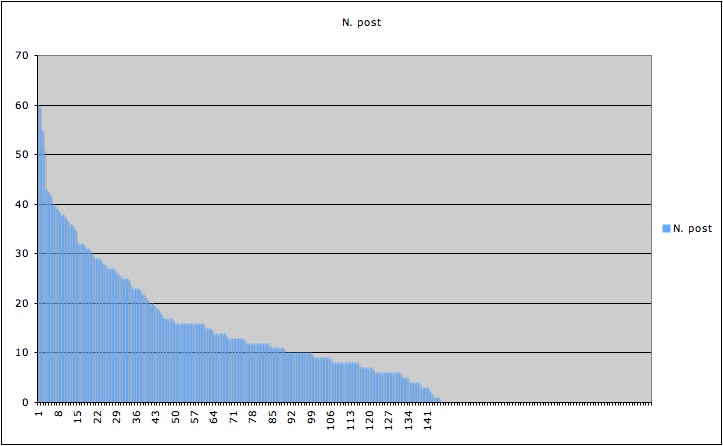
Total number of posts written during the three months: 2379
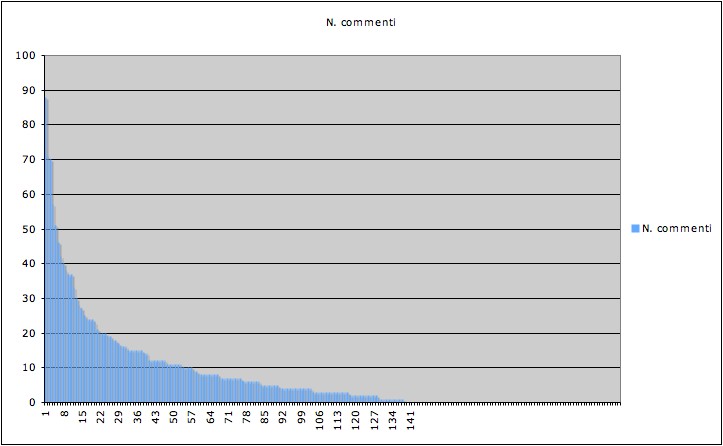
Total number of comments written during the three months: 1691
For each blog, I know how many posts have been written and how many comments have been received.
Distribution of posts written in each blog Distribution of comments received by each blog
It would be interesting to apply the analysis presented in Emerging networks to these data.
Two questions (before trying to write some code):
Is out there a tool to extract data from a given blog community (list of blog addresses)? For instance, extract, for each student, the number of comments written to a given other’s blog?
If we stay in this course as we stayed at school we will probably find ourselves out of the course. The same word course should be forgotten.
Assignments
The course has assignments but this does not means that all the assignments have to be done. One should write when feeling to have something useful to offer or something to ask for help, not just to have an assignment done.
We have not to write for the teacher (or against the teacher …) but to give something to others and, eventually, to receive something back.
Words
Words are very important. Knowledge cannot be always stored in words but, at any rate, words are a very powerful instrument to transmit knowledge. All powerful instruments should be used with parsimony. The minimum possible number of words that preserves a message is also the optimal number to transmit it in its entirety. More words will obfuscate it. Too many words may even annoy the reader.
The course is huge: long posts have less probability to be read.
Simplicity
Perhaps it is not bad to recall the six writing rules suggested by George Orwell.
Never use a metaphor, simile, or other figure of speech which you are used to seeing in print.
Never use a long word where a short one will do.
If it is possible to cut a word out, always cut it out.
Never use the passive where you can use the active.
Never use a foreign phrase, a scientific word, or a jargon word if you can think of an everyday English equivalent.
Break any of these rules sooner than say anything outright barbarous.
Moreover, this is an international course. For many of us, English is the second language and not all of us had an optimal English education. If native english speakers indulge in affectation some participants may be cut off.
The success of this course depends much on the yearning to share ideas and experiences, not on the desire to show its own smartness or, worse, its own pugnacious skills.
The tendency to dichotomize issues is always strong, mostly when the new is at stake.
The discussion in this (outstanding) course makes no exception, ranging from the thoughtful reflections of Lisa Lane to the maximalist tirades of Catherine Fitzpatrick.
However, dichotomizations are dangerous because one may easily miss the whole picture and its complexity.
A couple of examples.
Scientific literature – network
From an An Open Letter to the U.S. Congress Signed by 33 Nobel Prize Winners (pdf): For scientists working at the cutting edge of knowledge, it is essential that they have unhindered access to the world’s scientific literature. Increasingly, scientists and researchers at all but the most well-financed universities are finding it difficult to pay the escalating costs of subscriptions to the journals that provide their life blood. A major result of the NIH public access initiative is that increasing amounts of scientific knowledge are being made freely available to those who need to use it and through the internet the dissemination of that knowledge is now facile.
The clientele for this knowledge are not just an esoteric group of university scientists and researchers who are pushing forward the frontiers of knowledge. Increasingly, high school students preparing for their science fairs need access to this material so that they too can feel the thrill of research. Teachers preparing courses also need access to the most up-to-date science to augment the inevitably out-of-date textbooks. Most importantly, the lay public wants to know about research findings that may be pertinent to their own health diagnoses and treatment modalities.
The scientific literature is our communal heritage. It has been assembled by the painstaking work of hundreds of thousands of research scientists and the results are essential to the pursuit of science. The research breakthroughs that can lead to new treatments for disease, to better diagnostics or to innovative industrial applications depend completely on access not just to specialized literature, but rather to the complete published literature. A small finding in one field combined with a second finding in some completely unrelated field often triggers that “Eureka” moment that leads to a groundbreaking scientific advance. Public access makes this possible.
Enterprise policy – network An article entitled “An open secret” in the Oct 20th 2005 Economist issue reported that IBM in 2004 earned 3,248 patents and pledged 500 software patents to the open source community (IBM invested $1 billion in Linux), to allow open source developers to use the innovations and without risk of infringement.
When asked why would a firm that cares so much about intellectual property want to give it away, Mr Kelly, the head of the company’s intellectual-property division, answered “It isn’t because we are nice guys” and he explained that the reason was to fear that patent rights have swung so far towards protection that they risk undermining innovation.
The question is not about sticking to the good old or to be infatuated with the new, but to find a reasonable balance for any given context.