Vedo che questo blog viene pascolato anche quando lo lascio incustodito. Informo allora i frequentatori nonché i visitatori occasionali che non sono scomparso, almeno per ora, ma che nel periodo estivo scrivo molto meno. Del resto, il fatto che il blog sia ormai uno strumento fondamentale nella mia attività di insegnante e ricercatore non fa di me un vero blogger.
Sopporto male le imposizioni come la routine e quindi la necessità di dover scrivere per forza qualcosa in preda all’ansia che il blog si addormenti. Che dorma pure perché in estate ho da fare altro e, a prescindere da ruzzi e relax di altro genere, questo è periodo propizio per studiare, riflettere e magari costruire qualcosa di nuovo.
Non è detto che non scriva più niente fino al prossimo ottobre. Eventuali post imprevisti appariranno sotto a questo che ho momentaneamente “appiccicato” in cima alla pagina.
Detto questo, caro visitatore occasionale, tu sei ovviamente benvenuto anche se, da amico, ti consiglio di approfittare del tuo tempo libero per fare di meglio, magari qualche bella passeggiata dalle tue parti che certamente non saranno prive di luoghi ameni da visitare.
Se poi sei proprio preso da insana curiosità di sapere cosa stia facendo, qui di seguito te lo racconto volentieri seppur brevemente …
Yes, let’s go for a walk in a wood and relax as many times as you like and with the passing of time you will know that wood in your own way. This means you will be looking for something there and you will disregard the rest.
Jørgen asked me if I’m establishing valuable connections in this course. Yes, I do. Moreover, patterns begin to emerge and it is easier to choose what it is worthwhile to follow but the choice is personal, depending on its own interests and needs.
As far as my connections are concerned, these depend on my wish to improve what I’m trying to offer to my student. Specifically, I’m willing to
1) share my teaching experiences
2) learn from teaching experiences of others
3) gather some general background that may improve teaching practice
4) learn about some useful tools.
Consequently, I like posts that report on teaching experiences or make points that may be of some interests in real teaching practice. In particular, I’m interested in experiences made to test the idea that by means of Web 2.0 tools it is possible to improve the learning experience of students substantially.
For instance the blogroom I’m trying to describe in this blog, represents the attempt to transform the classroom group in a network where concern for others, responsibility for contribution, commitment, getting something accomplished are basic values. Values that are extraneous to the classroom group, where each student works for himself and almost only for a good grade, which rarely means to get something accomplished, I mean really accomplished. I have hundreds of students saying this when asked to give their opinion about the course, four of them provided a translation.
When talking about networks applied to education we should think to a farmer taking care of its field and its crops. With farmer I intend the contadino of first or middle 900 in Italy. Old farmers loved their piece of land and knew what to do to let crops grow by themselves.
We cannot say: “Look these networks, what a mess!” Of course, if there is nobody to take care of them. This is the role of the teacher in network teaching: to create conditions so that the students will learn, share, cooperate, really achieve something autonomously. And they love it if only we give them an opportunity.
In classroom groups the teacher controls processes. In networks teaching the teacher takes care of its network, as the farmer takes care of its crops. We have to love our students. We have to love our network of students. It is such love that will guide us in using technologies appropriately.
Now I have seen, with great joy that there are people sharing, in some ways, this vision.
There are other blogs that often give me the feeling to learn something useful when I read them. I will put them in the blogroll here but I’m afraid to miss something interesting somewhere. Therefore, a couple of questions:
If someone is reading this post feeling to have similar experiences to share or to quote, please, let me know.
Is there anyone who is thinking or even trying to extract some patterns of clustering in this course? I mean to find who is primarily interested in theories, or ideological aspects, or sharing teaching experiences and so on?
In other words, if, for instance, I find myself looking for mushrooms more and more often, well, this means that probably my way of knowing the wood is through the mushrooms I can find there and I will look for mushrooms, definitely, trying to not miss the good ones.
Oh, I enjoyed Valdis Kreb`s presentation Emerging networks (there are .pdf slides) very much. Pretty new stuff for me. I would like very much to try this kind of analysis in my blogrooms. Let’s make an example to look for useful hints.
With blogroom I mean the subset of the blogosphere constituted by the blog of my students. The students have the option to use a blog or to follow the course in a conventional way. If they choose the blog they can use it exactly as one uses a new exercise book: when the course is finished they can continue to use it, they can keep it for record or throw it away. Some more details on the blogroom and on students opinions are in a previous post.
Here I focus on analysis of the results.
The example refers to the class of medicine, 220 students (19-20 year old), first year of curriculum, Spring 2008, three months course on computer literacy.
Distribution of activities:
145 entered the blogroom
30 studied contents and made a final multiple-choice test
7 cooperated in an open educational resources project
38 not yet finished
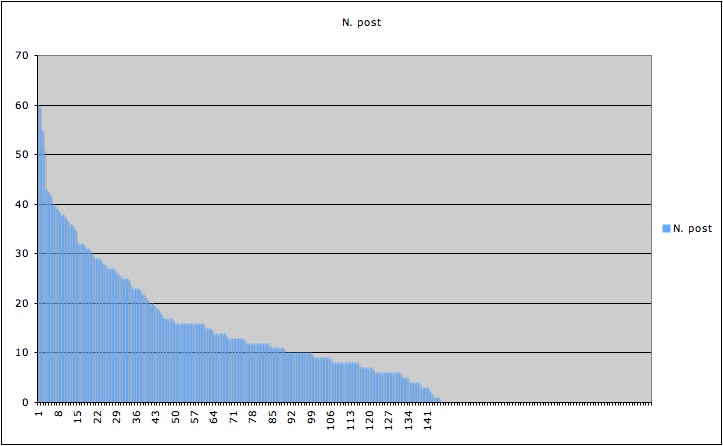
Total number of posts written during the three months: 2379
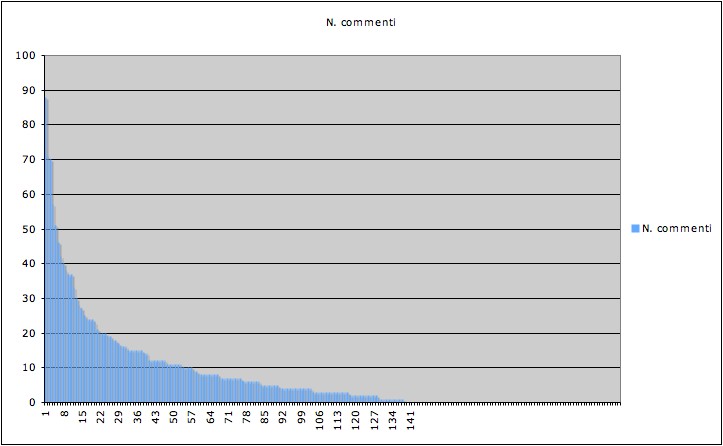
Total number of comments written during the three months: 1691
For each blog, I know how many posts have been written and how many comments have been received.
Distribution of posts written in each blog Distribution of comments received by each blog
It would be interesting to apply the analysis presented in Emerging networks to these data.
Two questions (before trying to write some code):
Is out there a tool to extract data from a given blog community (list of blog addresses)? For instance, extract, for each student, the number of comments written to a given other’s blog?