CCK08: final project

(Translation in Italian)

Hating scholiness and loving learning (to use Clay Burrel’s words), a strong yearning for changing what is related to school and learning, the necessity, perhaps, to discover other ways to take care of learning, the difficulty to share new paths with colleagues in my environment, were all powerful reasons to be irresistibly attracted by the idea to participate to the CCK08 course.

At the same time, the simultaneity with the bulk of the activities in the semester, was an equally strong reason to give up the idea of participating.

However, sometimes behind an apparently ineluctable dichotomy one may see a third possible way. In this case, instead of choosing if taking care of my students or playing the role of student myself, I decided to make the dialog among students and teacher the true participant to the CCK08 course.

The experience was very good because now I have a network of people having similar yearnings from whose I can learn further and get inspiration. I don’t know if such network is a sign of the existence of a grassroots movement, I hope.

In the last part of the course I was no more capable to follow very much the network but this was somewhat intentional. Being pressed by the overwhelming quantity of CCK08 connections and by my own teaching schedule it would have been impossible to do more. Thus I concentrated on 1) trying to keep an open window on the activities of my students and 2) recording possibly useful connections for the future. Now the network is there and when time will permit I will try to exploit those connections as well as new ones.

The CCK08 experience reinforced the general idea of teaching and learning I have been developing thus far and that I try to recap in the following.

Contents are no more the most important feature, they are in the wiki and are supposed to be integrated with available OER. Contents in the wiki are authored also by students.

There is no true time schedule. The teacher suggests activities in a certain succession but students are free to undertake them when they like. Time is not an issue, activities related to other curricula permitting.

The assignments given by the teacher are not true assignments, they are given mostly because students expect them. However those assignments are thought as lures to trigger autonomous learning activities.

I completely gave up the idea of covering the course topics with some degree of completeness. Instead I’m aiming to let each student find a personal path around the subjects of the course.

Since the course is given in an university curriculum I have to give grades. However, in my perspective it’s not much about giving grades, rather letting learners accumulate their grades by means of activities they do, both the suggested ones and specially the spontaneous ones. The final grades depend for some 70

As far as the evaluation of quality is concerned, creativity, attitude to extend the subject, cooperation with peers, openness and sharing are the elements I consider most relevant.

The course is delivered by using only free web tools such as blogs for communication among the participants as well as with the professor, wiki pages for use and creation of contents, group blogs as forums, Google Docs for cooperative works, or similar tools. We could say simply that we are using Web 2.0 tools and this is largely true. However I like to stress that the important points are those mentioned before. The use of Web 2.0 is important but only because it facilitates this approach very much, however it is not the crucial point per se.

I avoid to use any kind of close environments such as learning management systems, both in proprietary and open source flavours.

Being aware of the fact that web tools are run by companies, I try to manage things so that possible damages to the course, because of failures or some sort of closures of a single web service, are very limited. Web tools are used only if they permit thorough backups in open and standard file formats.

Admittedly, the subject of digital literacy is particularly suited to such an experiment, for a number of reasons.

  • The matter is evolving fast, it is impossible to freeze it in contents. It is also difficult to update it every year (or semester?) because it is also very large.

  • The spread of the starting background of students is discouraging. In the same classes you may have geeks as well as people who feel quite unfamiliar with new technologies.

  • Young people are digital natives. This statement sounds contradictory with respect to the previous one but it is not. The expression digital natives does not mean people who already master new technologies to but people that learn very fast to use them if put in an appropriate learning context. They learn fast because they breathed technology even when they believe to be unfit to it.

However, I believe that other subjects could be tackled with a similar approach, mutatis mutandis. What is important in my view is to create situations that allow students to get familiar with the subject so that they can learn by themselves. I believe that in any field it is possible to organize such kind of experiences. Technology may be very helpful but the key point is the intention I mentioned before.

I’m also aware of the fact that probably it is not possible to meet the objective of achieving a school well fitted to the needs of society by means of a reschooling process. I must admit to believe more in some sort of deschooling process. However, finding myself in the university and having the opportunity to work with about 700 students per year, I believe it is worthwhile to try to create new learning contexts by hacking the reality where and when it is possible. At least we may learn something useful. Among the connections that the participation to the CCK08 course helped me to revisit, there is the inspiring experience of Michael Wesch, very important in my perspective.

Therefore, my project is to continue along these lines while carefully listening to the CCK08 connections and the new ones that will arise.

etica hacker in piazza, no via, nel sottopassaggio …

untitled-2-copy

CCK08: before trying to outline a “final project” …

(Translation in italian, Translation booking)

Before trying to outline a “final project” I would like to hear the voices of the students. Yes, because first of all, teachers must learn to hear the voices of their students, before applying methods, before thinking about theories, before outlining strategies.

For me, it was not much about incorporating connectivist principles in my design and delivery of learning but the other way around, in a way. In eight years of activities, I went on through a series of steps listening to the students constantly, much as a steerer is listening to the winds on its sailboat. Then I found myself in a new place. It was quite pleasant but I wouldn’t have been able to describe it except in a rather fuzzy way.

In the meanwhile I heard some people talking about a place that seemed to me very familiar and they called it Connectivism. Well, I’m not completely sure we are talking about the same thing but anyway the two places should not be very far apart.

Coming back to the students, those of the present semester are still working. Thus I let you hear the voices of last year. They are collected in a page of my feed aggregator but we prepared a translation of a sampling of them.

students_voices_4

  • Thank you very much prof because you let us express ourselves with no pressure and because you took us away from that routine which is, for us, made up of only exams. A lot of pages that we need to learn by heart which we instantly forget after the exam… for your course, well, everything will be different!!!!.
  • First of all, I’d like to say that I was in that 10
  • The web 2.0 is not compulsory related to Medicines (actually, it is fully related to this discipline!), but it is for the ideas behind the web 2.0 that we must study this subject in order to be well-prepared as physicians.
  • I can say that this course has been weird. Different, completely different from what I had been facing until now. With my own job I should be ready to any innovation… But when the Prof. said: well, guys, you have to make a blog, the first thing that came up to my mind was: ok Prof., I’ll do it only if you pass over me!… Anyway, I did it: I created my own blog. And for the first time I didn’t feel like a machine repeating words after words: I felt a real person. In this ocean of books, once in my life I found a shining drop!
  • I suddenly liked the idea of a blog. At least for the chance to interact with other students and with the Prof. himself other than in the university atmosphere. The digital literacy course has been more than something relegated to the university: we talked about the use of language, the relationship among students, the relationship doctor-patient….
  • The beauty of all this has been not only the new approach, which is always positive… also because if this method had been spread to other subjects, my enthusiasm would have been the same and it will certainly be the same once that the astonishment for this new method has faded…
  • That is the peculiarity of Prof Andreas and his way of teaching! First digital literacy lesson: a lot of words and an argument which sounds weird to everybody: no regular lessons (that is to say classroom, students behind a desk, teacher talking continuously about things hard to understand, lots of notes, frequency attendance, but also tons of yawns from the students and too much boredom!!), but the Prof. will always be at our disposal in the computer lab to help us… and to talk about anything!!!
  • We went through this experience and it’s time to take stock of this novelty. Let’s start from the beginning. I must say that when the teacher proposed to us this different type of exam through a blog I was struck, even for a moment. Just because it is a type of assignment that everybody can demand to an expert, then because the Prof. had to be absent during the whole process. I found it a bit weird. Then, taking into account my inexperience, I saw a lot of difficulties in my path as I felt alone. I had a strong doubt on whether to make a traditional exam or not. But the need to make something new has been stronger. No books, no traditional exams, no stress that specific day when your performance is never great. Then I just gave it a try (…) The evaluation is absolutely positive. Only a negative remark: the Prof was not always present….
  • I was surprised by this attention not to the contents of the subject but to the best method for the students: not a simple referential way of teaching, as it often happens (with bad results, of course…) This course has been a real fight against the general indifference, the nepotism, the favouritism and against all the scum of the Italian Education system. I believe everything will remain, with the same speed this adventure had.
  • Well, well, well, what did this experience mean to me? First of all the university profs are not all serious, they don’t forcedly wear a tie and talk or make questions in a serious jargon (obviously, within certain limits). Then it showed me that not always the Prof acts like he’s a cut above the students. Or rather, you can be peer to him without offending…
  • We have to say that the organization of the course has been void of any ideology, but incredibly full of ideas. Can you understand the difference? I think the basic idea is what emerges in the concept of blog itself, of wiki pages and twitter: communication, sharing collaboration, elaboration. In my opinion, these are the four essential moments of social networking and, generally speaking, of any activity with success as an aim. Think about it for a while: almost all physiological aspects in the tissues- just to always refer to medicine- involve the communication between close cells, the exchange of metabolic and other specific cells, the collaboration for the elaboration of a product, a chemical reaction, the synthesis of materials. I think a lot of people have received and appreciated this social message, so that it has been a specific subject of our discussions in the university.
  • Ok, the notes are always there to stress you, but in this case, a part from the always-recurring number on your university carnet, this exam will remain with us… It will be something made directly by us.
  • another thing I appreciated, maybe among everything, is just the diversity of this course: I imagined only lessons on data processing, notes etc… Actually, what we had the chance to do are not the classical things which are common to all courses. These were unique activities that I think, unfortunately, we will never do again. They are unique but the beautiful aspect is that, notwithstanding this condition, they are very useful from a didactic point of view. Writing on my blog, reading others’ ones, discovering the functions of PubMed, Twitter, Google Docs, Google Maps, and much more, I’ve learnt a lot of things. More than I could do only studying a book.
  • I think one of the pros of the course as it is actually organized is the operative and presentation of this concept: we had the chance to discover and not to memorize some procedures (which, as for the study of digital literacy in a faculty like medicines, is quite irrelevant). The only thing I personally find a bit inappropriate is the absence of the spirit of challenge: all the assignments should have been universally approachable, which made it necessary to emphasize the content rather than the computer(as a tool), but also as for this field, I would have preferred at least one optional track really engaging.
  • And then… what can I add… dear Andreas, not so bad: you’ve read all our vicissitudes for 6 months, you know all our adresses thanks to Google Maps and all our maniac curiosities for illnesses thanks to pubmed… I think it hasn’t been so bad :-).
  • This is the digital literacy course, as for my personal experience, which made me think constantly about some problems I had only superficially faced. Thanks to it, I appreciated more the University which was stifling me.
  • There have been some things that struck and involved me a lot, one above the others: the I care seminar, which had as a consequence my decision to enter the clown group. The only thing of the course that I didn’t appreciate was the initial obsession of the Prof about the assignments….

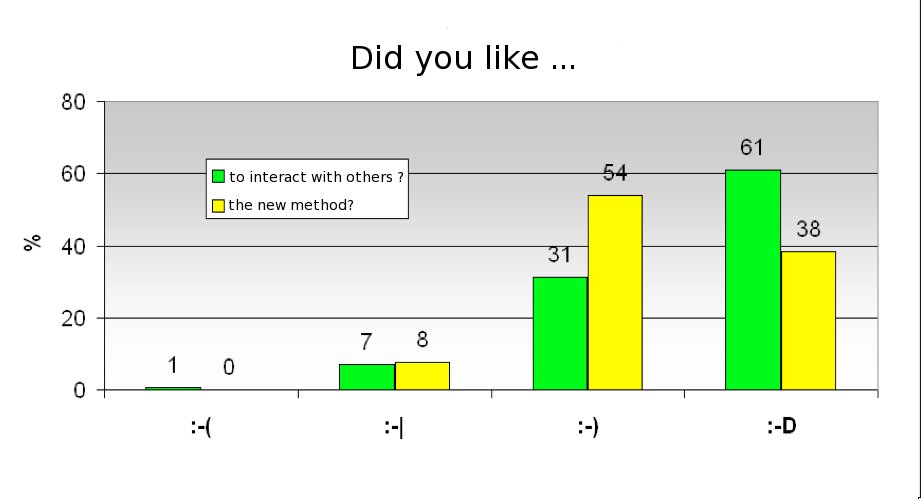
I know that results have to be expressed in numbers in order to be as objective as possible, but I believe that they are not sufficient when humans activities are concerned. For instance, are we sure that it is possible to describe a mood only with numbers? And, if not, should we ignore the mood of students when talking about learning?

Anyway, we did also extensive polls and the following is one of the basic results.

poll_1


I have to credit here

  • Maria Grazia Fiore who followed with me the blogroom last year and helped me in organizing the very large amount of data at the end of the courses
  • Emanuela Zibordi who analyzed the results of the polls
  • Ilaria Montagni who provided the translation of the students voices

These people are all volunteers that have been involved by seeking connections on the net.

CCK08: assignment 4

(Translation in Italian)

In the last assignment we focused on the concept of intellectual property by reading the Bound by Law comics and, on the more technical side, we looked at the pdf file format, with which that comics is distributed online.

The collection of contributions in a wiki page is very nice. It is plenty of interesting information and it is quite amusing to read: there is even a description of pdf in rhymes! Someone took care of the general layout of the page. Very good.

After having considered the issue of intellectual property, I suggest to read this post where an Open Letter to the U.S. Congress Signed by 33 Nobel Prize Winners is quoted. The letter is about the problem of distributing free of charge scientific publications.

There is a very powerful tool for finding medical literature: PubMed. It is an important tool for people working in the field of health care. I invite you to play with it. Try to pose you a question and see what you can find. Try to manage the quantity of available information in a meaningful way for you. Explore the possibility to download full text papers.

Write a post describing how did you play with PubMed.

CCK08: learning lines

(For students: Translation in Italian, please book yourself before beginning the translation)

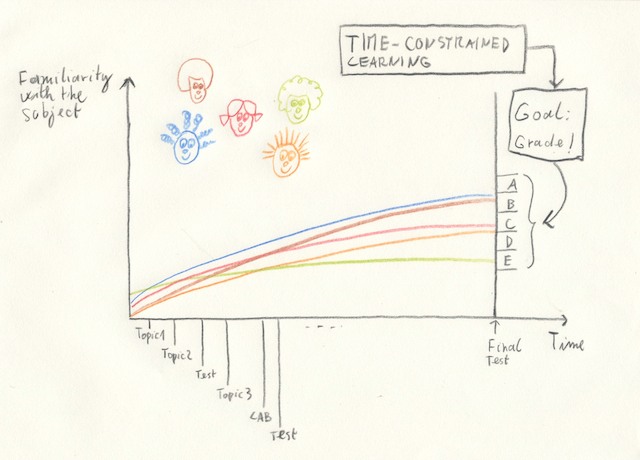
Yesterday in a classroom I was trying to explain the rationale of our courses and it happened to me to sketch some sort of learning lines. The sketches seemed to be of some use.

Here you have a somewhat refined versions.

learning11

In conventional classroom work, activities are time constrained. There is a tight schedule and a sort of photo finish with final ranking. Time constraining prepares the students for modern hectic life, this is true, however the learning process is vastly sup-optimal.

I could have written Learning on the ordinate but the term is abused. I prefer Familiarity with the subject of the course, it’s more akin to what I have in mind.

learning2

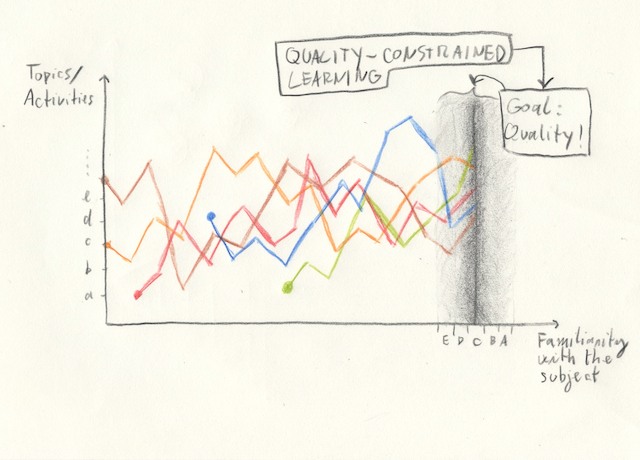
The idea here is to forget about time and focus on a sort of quality constrain.  Students wander through the topics/activities suggested by the teacher who is available to help and give advices.

Of course, everyone starts from its own preexisting Familiarity with the subject but everybody will finish around the given mininum familiarity, with a certain margin to do better if they like. That is, the teacher informs a student, when asked: “You are at C, if you want to improve your grade, you can work further”. It is the student who determines the end of the course.

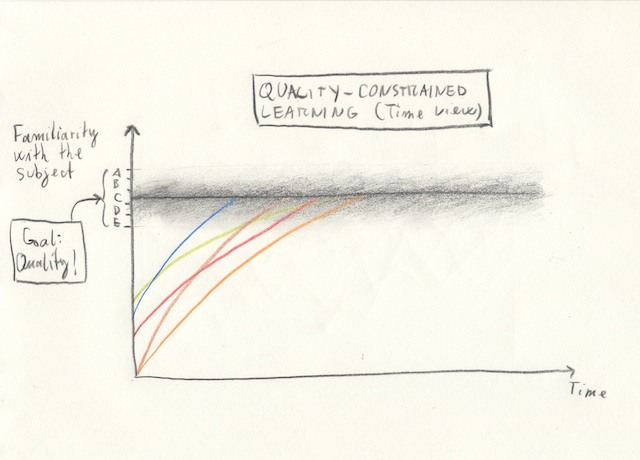
What about time?

learning3Everyone has its own time, that’s why I’ve dropped the time constrain. If you require more time to achieve the minimum required familiarity with the subject, it does not means that you are worse than others, it simply means that this is the time you need given all the other activities and problems (may be headache …?) you may have in your life. These contingecies should not hamper the quality of your learning.

CCK08: assignment 3

(Translation in Italian)

Here you have another assignment for students of the Facoltà di Medicina (INF08) and students of Teorie della comunicazione (TCO08). The attribution for the two groups are just an indication, all of you can choose one of the variants or do both of them.

Students of Teorie della comunicazione (TCO08)

Last monday in classroom we tried to focus on what’s really new in the internet hype. Among other things, we talked about the open source movement and the openness, sharing, peering and global action that characterize the behaviour of an increasing number of companies and organizations in the world. A very important aspect in this context is the evolution of the idea of intellectual property.

Let us try to  deepen this idea by reading Bound by Law, a comics created by two lawyers and a cartoonist. It can be downloaded and there is also a template to provide a translation in other languages …

Write your impressions in a post.

Students of the Facoltà di Medicina (INF08)

Well, read the same comics. By the way, you can download it as a pdf file.

Why the pdf exists? Where is it appropriate to use it? Are you already using pdf? In which ways?

  1. Write a post describing one specific feature or use of the pdf format.
  2. Transcribe it in this wiki page. Sign your transcription with a link to your blog post.

Before writing the post go to see in the wiki page what others have written in the meanwhile, so as to avoid duplications.

Use the contents in the wiki as well as any other source in the internet. Quote the sources you used.


Remember that, if they like, INF08 students can do the assignment for TCO08 students and viceversa, or  both the assignments.

The second part of the INF08 assignment can be seen as a little experiment about collaborative writing of a sort of manual. The TCO08 students could study it as an online communication experiment …

Last, remember there is a limit for the post length, let us declare it in binaryland language:

11001000 words!

OPML file and forum

(Translation in Italian)

The OPML file with your feeds is updated. I have also put the link in several places in the wiki.

One of you asked me where to write news so that every body sees them. You can use the forum we used last year. Actually it is a group blog but the functionalities are the same, basically. Everybody can read and comment it. If you want to write messages just email me for enrollment.

CCK08: my assignments are optional …

(Translation in Italian Translation booking)

Are my assignments mandatory? It depends.

There are students that overreact by doing a lot of things. Good. For these students my assignments are optional: do them only if you like to contribute on the subject I’m proposing.

Assignments are mandatory for those students who don’t know what to do. In the following, if you are going to warm up, assignments may become optional …

CCK08: when students become frustrated …

(Translation in Italian Translation booking)

Egocentricamente commented on the assigment 2 post that she finds enormously easier excel than google spreadsheet but she acknowledges to get nervous when becoming frustrated. I like this sort of comments because they foster discussion.

It depends on what you want to do. It may be that google spreadsheet is not appropriate for what you are used to do with excel. I propose you write a post about the difficulties you have found in using google spreadsheet. Then, if other people turn out to have ideas about this issue, you could write a page in the wiki to specify the differences between the two tools or you could improve this page written by a student last year. It may also be that others are aware of other similar tools.

This course is not about learning some specific tools rather it is about getting accustomed to learn new things and to become flexible in using each tool when appropriate in that given context.

That said, let me list some of the features of internet spreadsheets and internet docs, mutatis mutandis:

  • internet docs can be shared and they are very good to cooperate
  • they cost nothing
  • they offer some 10
  • you can work from every place where is an online connection
  • software is always updated, no need to bother with versions -> further costs
  • forms associated to spreadsheets are extremely useful, I’ m using them very much for the administration of this course
  • documents can be exported n the most useful formats.

Anyone willing to contribute to pros and cons?

CCK08: assignment 2

(Translation in Italian)

Keep a diary of your activities.

  1. Go in Google Docs and create a new spreadsheet.
  2. Name it with your first and last name.
  3. Keep writing there your activities as I have shown in this example.
  4. Write there what you have done and the URL related to the activity: posts in your blog, contributions in the wiki, translations and so on.
  5. Evaluate your activity with a grade among 1, 2, 3, 4, 5.
  6. In a cell somewhere in the spreadsheet keep the average of your grades updated.
  7. Share your spreadsheet with me filling the Share with others form in the following way:

With this assignment we do a number of different things.

  1. I always claim to grade all your initiatives, particularly those aimed at cooperating and helping the others. However I may miss something. By writing a diary of your own activities you will help me in keeping trace of your work. This means I have less mindless work to do and more time to do useful (hopefully) things for you. It is a kind of work sharing.
  2. The request to grade its own work may sound strange. By grading it you are exhorted to reflect more on the value of your activity, since the most severe judge of your work should be yourself. With this grade you should declare how much are you satisfied with your work. If it turns out you are not satisfied, well, go back and revise it.
  3. You practice a bit with Internet software and this is good. For many of you this course has to do with digital literacy, after all.
  4. You practice a bit with spreadsheets. Sometimes, quite rarely, someone asks me: “I would like to learn Excel”. Well, begin by playing with Internet spreadsheet software … for instance by calculating the average of your grades 😉